There is a significant difference between (a) how a browser chooses to
display a URL and (b) whether it accepts and goes to the expected page.
Punycode in (a) is often triggered by whether the browser is trying to
indicate that there is something odd about the URL.

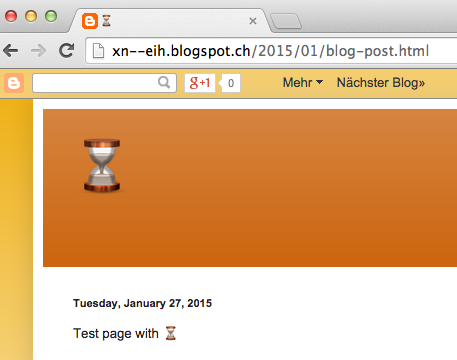
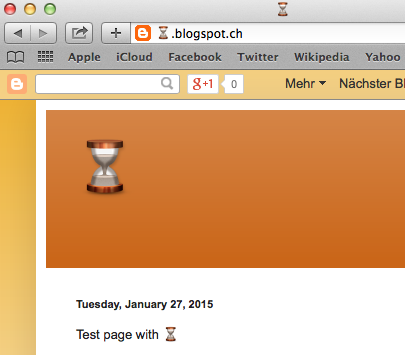
For example, http://xn--eih.blogspot.ch/ displays for me currently on the
Mac as the following. (I don't have a Windows 8 machine handy.)

Note that Chrome (Canary) displays as punycode, but actually goes to the
expected page.

*Firefox*
[image: Inline image 3]

*Safari*
[image: Inline image 4]

*Chrome Canary*
[image: Inline image 2]


Mark <https://google.com/+MarkDavis>

*— Il meglio è l’inimico del bene —*

On Tue, Jan 27, 2015 at 4:38 AM, Viktor Dukhovni
<ietf-dane(_at_)dukhovni(_dot_)org>
wrote:
On Tue, Jan 27, 2015 at 02:11:42AM -0000, John Levine wrote:
Of course, you can put any crud in the 3LD and below, but that's
always been true.
Indeed.  For example, Safari seems to be based on IDNA 2003, and
displays

    xn--ls8h.example.com

(U+1F4A9) as

    <glyph for smiling pile of poo>.example.com

while Firefox and Chrome manage to avoid displaying that glyph,
leaving the domain in Punycode form.

--
        Viktor.